Automated Optimization
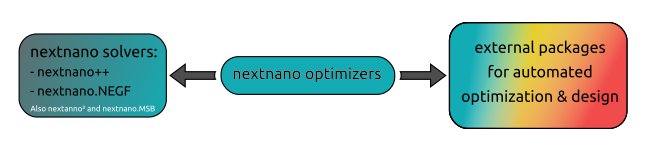
nextnano optimizers is a Python package developed to perform automated optimization of various semiconductor devices. It provides a Python-based bridge between nextnano simulations and well-established external optimization libraries. It is available within a separate license. Free trial license can be requested here.
All Methods You Need
The nextnano simulation tools enable sophisticated modeling of a wide range of physical phenomena in semiconductor structures and devices. Such simulations often involve complex optimization challenges that cannot be efficiently addressed manually and, therefore, require automated approaches. There is no single automated optimization method that is ideally suited to all applications. Therefore, nextnano optimizers offer a comprehensive selection of optimization algorithms, allowing you to choose the approach best suited to your specific problem.
Local Optimization Bayesian Optimization Evolutionary Algorithms
Local Optimization
Local optimization performs a local search for the optimal configuration. The algorithm starts from an initial guess for the parameters and improves them step by step, guided by evaluations made in the region explored so far. It therefore finds a local optimum near the starting point, which is not necessarily the best design in the entire parameter space. Hence, a local search aims to improve a given design rather than explore the entire search space. As a result, if the objective function has several local minima, different starting points may lead to different solutions. When applicable, it is often very efficient in finding local optimum within a few iterations.
Bayesian Optimization
Bayesian optimization explores a specified range of selected input variables and searches for a device configuration that minimizes a given single objective. The search is model-based. After each evaluation, the algorithm fits a computationally inexpensive approximation of the objective function to all previous observations. This approximation is then used to select the next simulation, aiming to make the search as efficient as possible. The main advantage of this approach is that it can find an approximate solution to the optimization problem using a relatively small number of simulations.
Evolutionary Algorithms
Evolutionary algorithms explore a specified range of selected input variables and search for a device configuration that minimizes one or multiple objectives. The search is population-based. A population consists of a set of candidates, each representing a particular device configuration. The nextnano solvers perform simulations for these candidates. The objective values are calculated from the simulation results. The evolutionary algorithm uses these objective values to construct the next population. This process is repeated over successive iterations, known as generations. Evolutionary algorithms are particularly attractive for problems with many optimization parameters, complex search spaces, and multiple objectives.
Flexibility
nextnano optimizers provides exceptional flexibility in defining both the semiconductor device to be optimized and the optimization objectives. The only requirements are that the device simulations are held by the nextnano simulator tools (such as, nextnano++, nextnano.NEGF, nextnano.MSB) and converge successfully.
Operation in a Nutshell
The device is fully defined (geometry, dimensions, materials, temperature, etc.) in an input file for your favorite nextnano tool. All optimization objectives and variables, as well as optimization settings (paths to input and output files, choice of algorithm, its hyperparameters, etc.), are specified in a simple Python script with a consistent structure across all optimization methods. The script reads the input file and performs an automated search over the optimization parameter space to find a device configuration that comes as close as possible to the desired design.

Ease of Use
Thanks to a consistent package structure across optimization methods, switching between algorithms is straightforward and requires only basic Python knowledge. This approach allows users to focus on what really matters: exploring new device concepts, improving performance, and accelerating innovation.



BSFZ-certified research and development